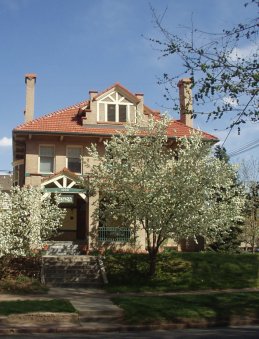
THE BRIND MANSION
THE BRIND MANSION
The Brind Mansion was built in 1908 for Mr. and Mrs. J. Fitz Brind. Mr. Brind owned extensive mining interests which included substantial ownership in the Butterfly-Terrible Mining Company. He was also president of Insoloid Fuse Company. Mrs. Brind's acclaim included her roles as president of the Old Ladies Home and the Denver Orphans Home. She was the first woman on the Executive Board of the Denver Organized Charities and a member of the Ladies Auxiliary Board of Mercy Hospital.

The mansion was designed for Maria Brind by Sterner and Williamson whose designs included the Daniels and Fisher Tower, the Metropolitan Building, and the C.F.& I. Hospital in Pueblo. The house was completed October 1, 1908.

Two years later, Mrs. Brind again commissioned Sterner and Williamson to design a two story addition to the house to expand the first floor library-parlor and a second story bedroom. The Brinds enjoyed the house for only a short while; Mrs. Brind passed away in 1914 and her husband eventually sold the house in 1919.


The house passed through many owners including several prominent Denver families. In 1994, the house was purchased by Spronk Water Engineers. SWE has worked to maintain the historical nature of the house while adapting it to the needs of a modern office. The Brind Mansion is architecturally eclectic, based on the Italian villa concept which was very popular in New York, Rhode Island, and other Eastern states about 1860. This basic preference may be have been a result of Mrs. Brind's childhood and early adult life in Chicago and her travels in other Eastern states and Europe.
It incorporates Romanesque woodwork at the eave brackets, at two bay windows, and with the heavy timbering at the front entry. The four very tall chimneys and decorative brick work arches over the 10th Avenue second story and first floor balconies are early Renaissance, with a brick work Tyroliene Cross of Northern Italy centered in each arch. The roof system's red tiles are also Northern Italian, as is the stucco treatment highlights at the massive side bay window, and at the gables. The iron work, especially the balconies and the massive wrought iron entry gates are reminiscent of those of Northern Italy which stretch from Milan to Venice.
 

There is a notable use of Italian marble, in a basket weave design, as the floor of the large entry porch. The marble theme is carried on as flooring for the immediate entry foyer, and is also used as a highly polished decorative foyer wainscoting. Also of special attractiveness are the brick work brackets used beneath the chimney caps and beneath the eave brackets, and echoed with the similar but more massive treatment supporting the second story bay windows.

This mansion is a very harmonious marriage between the Denver buff colored brick which was so popular in that era, and the Northern Italian architectural style that Sterner was so fond of two years later in their Daniels & Fisher tower which was styled after the campanile (bell tower) of St. Mark's Square in Venice.

First floor Foyer and Staircase.
The interior is architect designed and not eclectic. It is post Victorian and a combination of Art Nouveau and pre-Art Deco, with an abundance of trail blazing suggestions of the forthcoming period of art Deco in the woodwork, banister rails, and room dividers. The same is emphatic in the wall coverings.
The massive two story hallway and main first floor rooms are rich with original wall coverings which must be seen to be believed. The above mentioned hallway has an embossed and glazed original wall covering in the full spirit of Art Deco, and with the appearance of finely tooled Italian leather. The dining room features panels with coverings, in relief, of pre-Art Deco designed flora including square roses and tulips. In the same room, the square roses are picked up again in the leaded crystal glass panels used in French balcony doors and room dividers. Both the wall and ceiling coverings and the rich woodwork have been preserved to a rare decree of original condition.
Much of the original hardware and light fixtures are still in place and in use. The second floor features a sitting room with romantic Versailles wall flora and ceiling molds reminiscent of Louis XIV, and Louis XIV marble vanity - all of which are in original condition. 

Information from the "The Brind Mansion, 1000 Logan Street, A Brief History", compiled by Brent Spronk.


Spronk Water Engineers, Inc.
1000 Logan Street
Denver, Colorado, 80203-3011
Phone: (303) 861-9700  |  Fax: (303) 861-9799
Email: spronk@spronkwater.com
Site Powered By
eBizWebpages.com
Online Website Design